
Wild grapes create a spectrum of incredible purple colors when combined with water (or even if you just smush them on paper or your own hands). Wild grape ink is one of my favorites to work with because of the color, the smell, and how it handles. Because there is so much natural sugar (fructose and glucose) in the grapes, the ink is thicker than most other natural inks.
To create this ink, you will need ripe wild grapes. You can use commercially grown grapes if you don’t have access to wild grapes. Wild berries have more tannins (natural pesticides) than commercially grown grapes and will contribute a richer color.
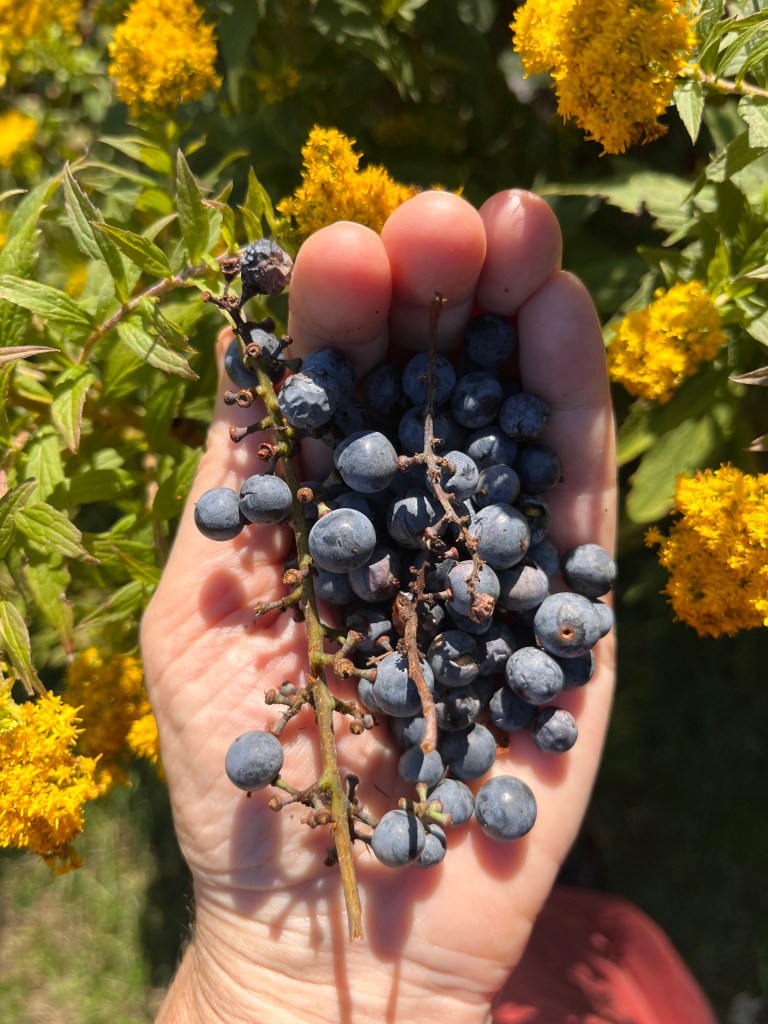
Wild grapes grow on vines that are most often found on the edges of fields and forests. They are border plants and thus have some important jobs: to offer food and shelter to other wildlife, to create a buffer to protect plants and animals from environmental disruption, and to build walls around forests. Because their role is pivotal to the balance of an area, please forage responsibly. Harvest small amounts and try to not disrupt the plants too much. That being said, wild grapes are very hardy, and they do like interaction. Border plant regions (the “edges”) can also be the home of poison ivy, nettles, and other prickly plants, and ticks, so use caution while foraging and harvesting and dress appropriately (pants tucked into socks and long sleeves).
You can harvest wild grapes as soon as they pass the “smush test.” Take a grape and smush it on your skin or a small piece of paper. And always ask first (read this great article, “The Honorable Harvest” by Robin Wall Kimmerer). If the smushed grape gives color, you are ready to harvest. If not, it is either too early or too late in the season, or there may be a drought in the region. Leaves those grapes intact. They will be wonderful food for birds but will not collaborate on creating ink.
I use gloves and clippers when I harvest wild grapes. If it is a bountiful season, I sometimes harvest a little extra and freeze these grapes to create ink with during the winter.

This Wild grape “sample” has a drop of Copper Oxide ink in a drop of Black walnut ink.
Recipe for Wild Grape Ink:
(This recipe also works for wild berries like chokeberries or blackberries)
1. Remove grapes from the vine. Compost any grapes that are dried out or overly ripe.
2. Combine wild grapes (or berry equivalent) and water in a 1 to 2 ratio (example = 1/2 C grapes and 1 C water) in a small pot.
3. Put the pot onto a heat source and bring the grapes and water to a boil.
4. Reduce heat and let simmer for 10-20 minutes, or until color is just right. Test the color every several minutes by dipping a small strip of thick paper (watercolor paper works well) into the ink.
5. Remove from heat and let cool completely.
6. Strain fluid/ink from the grapes and water into a bowl, making sure to squeeze any excess fluid from the grapes.
7. Pour the purple ink from the bowl into a glass jar, and add whole cloves. Whole cloves act as a natural preservative. Cover the jar and give a gentle shake to mix the ink and cloves.
I’ll share how to work with this beautiful ink in future blogs. But if you can’t wait, this ink works best on thick paper (either watercolor or printmaking paper).
Good luck and have fun!
This text and recipe are open source! Please feel free to share!
 Magical Nature Tarot