
Black walnut hulls create a beautifully rich brown color when combined with water. The resulting ink is wonderful to work with and fairly hardy. Black walnut hulls are loaded with tannins, a natural pesticide found in many plants. Tannins form strong bonds with the fibers they meet (like fabric or paper) and can result in vibrant colors that are more resistant to fading.
To create this ink, you will need black walnut hulls. The hull is the outermost protective layer around the nut. Each nut has a shell and a hull outside of that shell. It is the hull that is loaded with tannins, not the shell.
To find these hulls, start locating some black walnut trees. A great way to find black walnut trees is to ask around. Because the hulls have so much natural pesticide in them, they tend to kill a lot of other plant life around them. And because of this, most people want those hulls (or even the trees) removed. Once I started asking, people were not only requesting that I come pick up the hulls; they actually started bringing them to me. If you live in an area where there are no black walnut trees, you can buy them online.
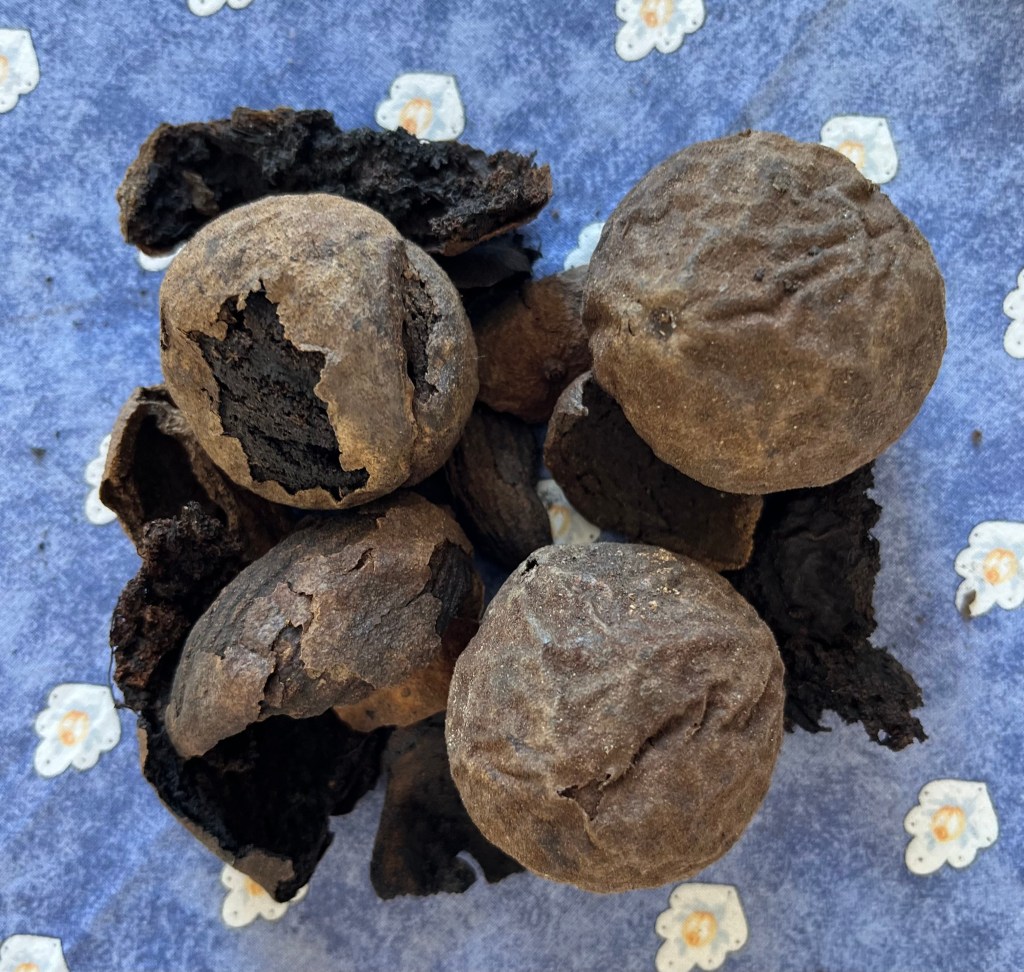
Start connecting with black walnut trees in the autumn. Look up and notice if there are green, egg-shaped items on the ends of the branches. These green things are the hulls. And then, wait until they fall. This is part of the relationship… visiting those trees, watching them, and learning from them. Once the hulls have fallen, notice if they are green or brown (or somewhere in between). Ideally, you want to collect them when they are brown. Green hulls have not started to break down, and you will need to boil them for a much longer time. This means that you will be using precious resources (whatever allows you to create heat on a stove or hotplate) to do something that happens naturally outdoors. Once you have harvested some hulls, dry them outdoors or indoors in a space that has good ventilation. I strongly suggest outdoors because occasionally there are little bugs (husk fly larvae) that are still working away on them.
Years ago, a friend gifted me some black walnut hulls. She had placed them in a shopping bag with a white interior. I noticed that there were brown lines all over this interior and had an idea. After I brought them home, I placed the hulls on some white paper on my back porch. And then I left them overnight. When I went to check on them the next morning, I found an incredible work of art! Eventually, these larvae will transition into flies and fly away, leaving you with some gorgeous hulls that break down easily and are great to work with.

The recipe below is for brown hulls. If your hulls are green, you will need to boil them for much longer (up to five hours!).
Recipe for Black Walnut Ink:
1. Remove brown hulls from the shell. This is the layer that you will boil down. If hulls do not come off, it is fine to boil with the nuts inside.
2. Soak hulls overnight in water in a 1 to 4 ratio (or approximately 1 hull or 1/4 C pieces in 1 C. water).
3. After soaking overnight, bring the entire mixture (hull/pieces and soaking water) to a boil. 4. Reduce heat and simmer for 30 minutes to one hour, checking every 10 minutes to make sure there is enough water. Test the color every ten minutes by dipping a small strip of thick paper (watercolor paper works well) into the ink.
4. Once ink is the desired color, remove from heat (often within 30 minutes). Let it cool. 6. Strain off ink into a bowl and put it to the side.
5. Reserve hulls in a separate jar (maybe even the jar they were soaking in). You can often get at least one more batch from these already-boiled hull bits. Label the jar and store it in the refrigerator until you are ready to try another batch. If you are not going to reuse them, you can compost them.
6. Pour the brown ink from their bowl into a glass jar, and add whole cloves. Whole cloves act as a natural preservative. Cover the jar and give a gentle shake to mix the ink and cloves.
7. Label the jar with the contents and date, and store it in a place that is safe from young children and pets. Because this ink is loaded with tannins (natural pesticides), it could make someone sick if they accidentally drink it. Storing the ink in a refrigerator will allow it to last longer.
I’ll share how to work with this beautiful ink in future blogs. But if you can’t wait, this ink works best on thick paper (either watercolor or printmaking paper).
Good luck and have fun!
This text and recipe are open source! Please feel free to share!
 Magical Nature Tarot